Congratulations—you’ve landed! While the excitement of moving to the UK is high, the first 30 days are a sprint of administrative tasks. In 2026, the UK’s “Digital by Default” system means most of your setup happens on your smartphone, not in a physical office.
From securing your National Insurance (NI) Number to ensuring your family is covered by the NHS, this guide breaks down the high-priority tasks you must complete to transition from “visitor” to “resident.”
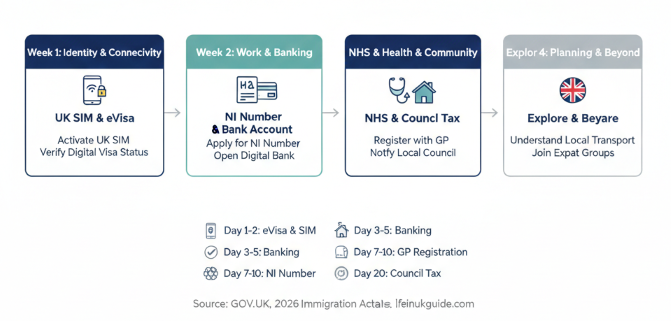
Week 1: The Identity & Connectivity Sprint
Your first 7 days are about “proving” you are here and getting connected.
1. Secure Your UK SIM & Proof of Address
You cannot open a bank account or register for a GP without a UK phone number and a way to prove where you live.
- SIM Card: Pick up a pre-paid SIM (Voxi, Giffgaff, or Lyca) immediately. Avoid long contracts until you have a credit history.
- Proof of Address: If you are renting, your tenancy agreement is your primary proof. If staying with friends, ask to be added to a utility bill or the Council Tax register immediately.
2. The eVisa Verification
Since physical BRPs are gone in 2026, log into your UKVI account within 48 hours of arrival. Ensure your “Status” has updated from “Issued” to “Active.” This is what landlords and employers will check via your Share Code.
Week 2: Working & Banking
Now that you are connected, it’s time to secure your finances and legal right to work.
3. Apply for your National Insurance (NI) Number
You need this to get paid correctly and avoid “Emergency Tax” codes.
- How to Apply: The process is now 100% online via GOV.UK. You will need to upload a “selfie” holding your passport to prove your identity.
- Timeline: Expect 4 weeks for the letter to arrive, but you can start working as long as you can show your employer your “Application Reference Number.”
4. Open a Digital “Challenger” Bank Account
Traditional high-street banks (HSBC, Barclays) often take weeks to verify newcomers. To get a sort code and account number fast:
- Recommendation: Use Monzo, Starling, or Revolut. These apps allow you to open an account with just a passport and a UK address, often within 24 hours.
Week 3: Health & Community
The UK’s social safety net requires proactive registration. It is not automatic.
5. GP Registration (NHS)
Do not wait until you are sick to find a doctor.
- The Rule: Everyone in England is entitled to register with a GP for free, regardless of immigration status. You do not need a proof of address or an NI number to register, though surgeries may ask for them to make the process easier.
- Action: Use the “Find a GP” tool on the NHS website and look for the “Register Online” button.
6. Council Tax Registration
If you are living in a house (not a hotel), you must notify the local council.
- Why? It is a legal requirement, and your Council Tax bill is the strongest proof of address you can own in the UK. It will help you get a credit card or a driving license later.
Summary: The First 30 Days Checklist
- Day 1-2: Activate UK SIM and verify eVisa status.
- Day 3-5: Open a digital bank account (Monzo/Starling/Revolut).
- Day 7-10: Apply for NI Number online.
- Day 14: Register with a local GP.
- Day 20: Notify local council of your residency.
Other Useful Guides
- How to Open a UK Bank Account with No Credit History
- Step-by-Step: Applying for your NI Number in 2026
- NHS Explained: How to get a Prescription and See a Specialist
- Understanding Council Tax: Discounts for Students and Single Occupants