Switching from a Graduate Visa to Skilled Worker Visa is a strategic move for long-term residency in the UK. In 2026, new salary thresholds and English language requirements (CEFR B2) have made this process more technical, but the long-term benefit of a direct path to permanent residency remains the primary driver for most professionals.
1. Eligibility and “New Entrant” Advantages
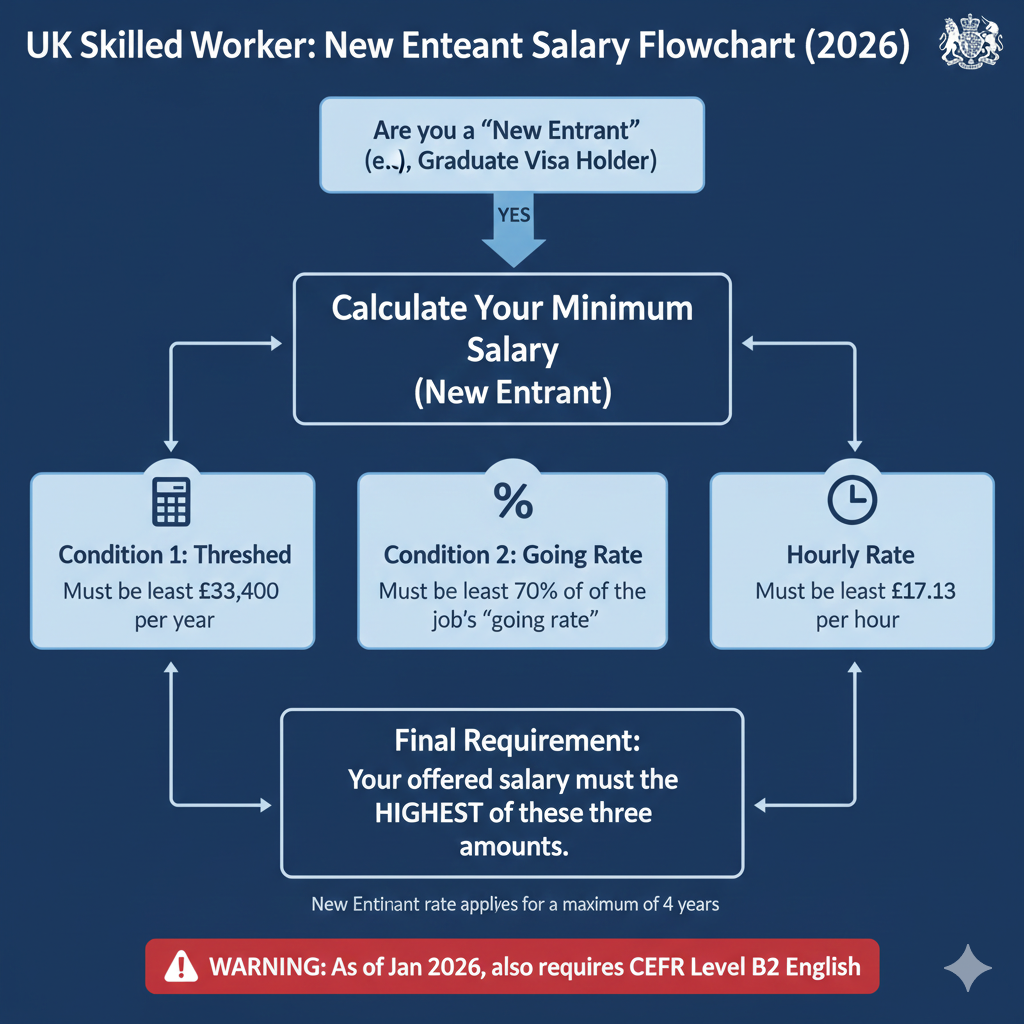
As a Graduate Visa holder, you qualify as a New Entrant for up to 4 years (total time including your Graduate Visa). This allows you to meet lower salary thresholds than an “experienced” worker.
Calculation Rule: You must be paid the higher of:
- £33,400 per year
- 70% of the job’s “going rate”
- £17.13 per hour
Key Requirements:
- Sponsorship: You must have a job offer from a UK employer with a valid Sponsor License.
- Skill Level: The role must be at RQF Level 3 or above (A-level equivalent or higher).
- Certificate of Sponsorship (CoS): Your employer must assign you a digital CoS with a unique reference number.
- English Language: Since you have a UK degree, you typically meet this requirement automatically. However, as of January 2026, the standard is CEFR Level B2.
2. Switching Graduate Visa to Skilled Worker Visa: Step-by-Step Process
The application must be submitted before your current Graduate Visa expires. The application must be submitted entirely within the UK. Do not travel abroad while the application is processing, as this will lead to an automatic withdrawal.
| 1 | Job Offer | Confirm the role is at RQF Level 6 or above. Some RQF 3-5 roles are eligible only if on the Immigration Salary List. |
| 2 | Obtain CoS | Your employer pays the fee and assigns you a “Defined” or “Undefined” CoS via the Sponsorship Management System (SMS). You need this 11-digit reference number. Ensure your employer is on the Register of Licensed Sponsors. |
| 3 | Salary Validation | Ensure the gross pay meets the £33,400 New Entrant floor or 70% of the role’s “going rate” (whichever is higher). |
| 4 | Online Application | Complete the form on the GOV.UK website using your CoS reference. |
| 5 | Identity Check | Most switchers use the “UK Immigration: ID Check“ app to avoid attending an in-person center. |
| 6 | Pay Fees | Pay the application fee and the Immigration Health Surcharge (IHS). |
| 7 | Decision | Standard processing takes 8 weeks, but Priority (5 days) is available for an extra fee. |
3. Financial Requirements (2026 Costs)
Both applicant and employer will incur specific costs during this transition.
Applicant Expenses
- Application Fee (Up to 3 years): £827 (Standard) or £551 (Shortage/ISL roles).
- Immigration Health Surcharge (IHS): £1,035 per year (e.g., £3,105 for a 3-year visa).
- Maintenance Funds: You must show £1,270 held for 28 days unless your sponsor “certifies maintenance” on the CoS.
- Priority Service (Optional): £500 (5-day) or £1,000 (next-day) for faster decisions.
Employer Expenses
- Certificate of Sponsorship Fee: £239.
- Immigration Skills Charge (ISC): £364 per year (Small/Charitable) or £1,000 per year (Medium/Large).
- Note: This is often waived for those switching directly from a Student/Graduate route, but HR must verify current 2026 exemptions.
4. Possibilities and Career Benefits
- Settlement (ILR): Unlike the Graduate Visa, the time spent on a Skilled Worker Visa counts toward the 5-year requirement for permanent residency.
- Dependants: You can bring or keep your partner and children in the UK.
- Stability: Your visa is tied to your professional role, providing a more robust standing for mortgage applications and long-term contracts.
- Second Job: You are allowed to work a second job (up to 20 hours a week) in the same profession or a shortage occupation.
5. Graduate vs. Skilled Worker Visa Comparison
Understanding the fundamental shift from an “unsponsored” to a “sponsored” status is essential for your career planning.
| Feature | Graduate Visa (Current) | Skilled Worker Visa (Target) |
| Sponsorship | Not required | Mandatory (Licensed UK Employer) |
| Job Flexibility | Work for any employer / Self-employed | Tied to a specific employer & SOC code |
| Settlement (ILR) | Does not count toward 5-year ILR | Counts toward 5-year ILR path |
| Salary Rules | No minimum threshold | Strict minimums (General or New Entrant) |
| English Level | Satisfied by UK Degree | Level B2 required (New 2026 rule) |
This video explains complete process how to swtich from graduate visa to skilled worker visa in UK according to 2026 updates
6. Frequently Asked Questions
Can I travel while my switch is pending?
No. If you leave the Common Travel Area (UK, Ireland, Isle of Man) while your application is being processed, your application will be automatically withdrawn.
What happens if I lose my job?
You will have 60 days to find a new sponsor and apply for a new visa, or you must leave the UK.
Can I stay as a "New Entrant" forever?
No. The "New Entrant" salary discount is capped at a total of 4 years (including time spent on your Graduate Visa). After 4 years, your salary must meet the "Experienced" worker threshold.
Can I switch if my Graduate Visa has already expired?
No. You must have a valid "leave to remain" at the moment you hit "submit" on your online application. Overstaying will void your right to switch within the UK.
What is the new B2 English requirement?
As of January 8, 2026, the English requirement for Skilled Workers rose from B1 to B2. While your UK degree typically covers this, some cases may require a fresh SELT (Secure English Language Test) if the degree was obtained over a decade ago.
Does my partner's visa switch automatically?
No. Dependants must file a separate "Switch" application to remain linked to your new Skilled Worker status. Their visa expiry will then match yours.
